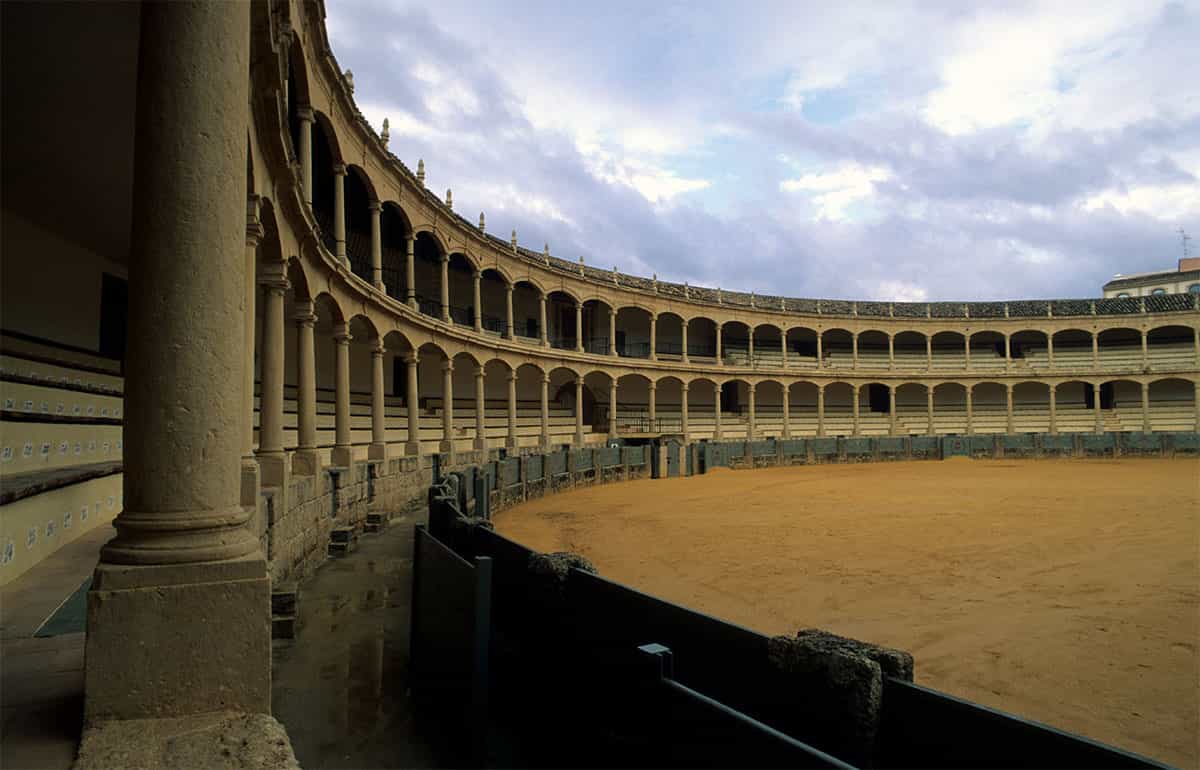
Ronda Bullring: Spain’s oldest and most monumental bullring

The Ronda Bullring is recognised as the oldest and most monumental bullring in Spain. Built in 1785, it originally served as a training ground for knights. If you visit Ronda, you cannot miss this landmark — the town is considered one of the birthplaces of modern bullfighting as we know it today. Its imposing neoclassical sandstone structure continues to impress thousands of visitors who explore the Serranía de Ronda every year.

The bullring belongs to the Royal Cavalry Academy of Ronda (Real Maestranza de Caballería de Ronda), an institution founded in 1573 by Philip II and historically linked to bullfighting and equestrian arts. For centuries it promoted discipline among the city’s riders and the breeding of quality horses. Today it continues to function as a school of classical dressage, combining its bullfighting heritage with an important cultural and educational role.

Interior of the Ronda Bullring

Visiting the Ronda Bullring is much more than simply seeing an arena: it is stepping into more than four centuries of history, tradition and art. A living monument that forms an essential part of Malaga and Andalusia’s heritage, and that will help you understand why Ronda occupies such a prominent place in the history of bullfighting worldwide.

*Opening times and prices may change. We recommend checking the official websites before your visit.

History, museum and traditions of the Ronda Bullring

Origins and construction of the bullring

Its construction arose from the need to defend the territory in 1572, shortly after the defeat of the Muslims. It was then that the Royal Cavalry Academy of Ronda was founded and games and training sessions began to take place. Among these exercises were bullfights — an exciting spectacle that quickly attracted the local population and became a fundamental part of the local culture.

By the 18th century, the knights had stopped fighting bulls themselves. It was popular figures, the toreros, who dedicated themselves professionally to this art. Bullfighting traditions have their roots in the Bronze Age and continue to be celebrated today in different parts of the world, although more and more places prefer events without the killing of the animal — with the exception of Spain. In the past, bullfights were held in open squares, until it was decided to build a permanent bullring, which was inaugurated in 1785.

The Museum of the Royal Cavalry Academy

The Museum of the Royal Cavalry Academy of Ronda offers detailed information about the origins and evolution of bullfighting over the years. Beneath the stands you will find the Bullfighting Hall, the Royal Harness Room, collections of antique firearms and an equestrian gallery. The visit allows you to understand how bullfighting has evolved from its beginnings to the art we know today.

The Goyesca: Ronda’s most emblematic festival

This festival begins in early September in Ronda and forms part of the Pedro Romero Fair. The Goyesca was launched in 1954 and features banderilleros and picadors dressed in the typical costumes of Goya’s era — hence the name of the celebration. It is one of the most special and anticipated bullfighting events in Spain, combining elegance, tradition and the unique atmosphere of the Ronda bullring.

Architecture and current use

The bullring, with a capacity of around 5,000 spectators, stands out for its double gallery of Tuscan columns and its noble neoclassical design. Although structural consolidation works are currently underway, the venue remains open to the public. In addition to occasional bullfights, it continues to function as a school of classical dressage, keeping the equestrian tradition of the Royal Cavalry Academy alive.

How to get to the Ronda Bullring from your accommodation

The Ronda Bullring is located in the historic centre of Ronda (Calle Virgen de la Paz, 15), just a few minutes’ walk from the New Bridge (Puente Nuevo). If you are staying on the Costa del Sol (Torremolinos, Benalmádena, Marbella, Fuengirola or other locations), you have several comfortable and flexible options. The usual route is via the A-357 and A-376, a journey of about 100 km that offers spectacular views of the Serranía.

Car hire for a trip to the Ronda Bullring from the Costa del Sol

Car hire: the most flexible and recommended option

Hiring a car allows you to leave whenever you want from your hotel or apartment on the Costa del Sol, stop at viewpoints, combine your visit to the Ronda Bullring with the nearby white villages (Grazalema, Setenil, Zahara de la Sierra) and manage your time with complete freedom. It is the best option if you are travelling with family or want to discover more of the Serranía de Ronda in one day.

Book car hire in Malaga
Private transfer to the Ronda Bullring from your hotel

Private transfer or taxi: direct comfort from your accommodation

If you prefer not to drive, book a private transfer from your hotel on the Costa del Sol or directly from Malaga Airport. You will be picked up at the door and dropped off right by the centre of Ronda. Ideal for families, groups or if you want to relax and enjoy the scenery without any worries.

Taxi from the airport

*Many services do not require you to enter credit card details or pay in advance. We recommend booking in advance, especially during peak season.

Other public transport options

Regular bus services (Avanza and other companies) run from Malaga bus station to Ronda in approximately 2.5 hours. There is also a train connection from María Zambrano station (Renfe Media Distancia). Once in Ronda, the bullring is a short walk from the centre. These options are more economical but less flexible if you want to combine several places in one day.

Practical tips for visiting the Ronda Bullring

  • Buy your tickets in advance on the official website of the Royal Cavalry Academy (rmcr.org) or at the ticket office. The visit includes the bullring, the museum and the collections.
  • Approximate opening hours (subject to change): November–February 10:00–18:00 | March and October 10:00–19:00 | April–September 10:00–20:00.
  • Approximate prices: General admission €9 | With audio guide €11 | Groups (15+ people) €7 | Children up to 10 years old free.
  • Wear comfortable shoes. The site has cobbled areas and stairs.
  • Combine your visit with the New Bridge, the viewpoint and other monuments in Ronda’s historic centre.
  • If you are travelling with children, this is a highly recommended cultural visit suitable for all ages.

Frequently asked questions about the Ronda Bullring

Is the Ronda Bullring the oldest in Spain?

Yes, it is recognised as one of the oldest and most monumental. It was inaugurated in 1785 and retains much of its original structure.

What is included in the entrance ticket to the Ronda Bullring?

The ticket gives access to the bullring, the Bullfighting Museum, the harness collections, antique weapons and the equestrian gallery. Audio guides can also be purchased.

When is the Goyesca held in Ronda?

The Goyesca takes place in early September as part of the Pedro Romero Fair. It is one of the most special bullfights in Spain because the participants wear historical costumes inspired by Goya.

Can I visit the bullring even if there are no bullfights?

Yes, the Ronda Bullring and the museum are open to the public every day of the year for tourist visits, regardless of bullfighting events.

Are there currently works taking place at the Ronda Bullring?

Structural consolidation works are currently underway. The venue remains open to the public, although it is advisable to check the current status before your visit.

Is it recommended to drive from the Costa del Sol?

Yes, it is the most comfortable and flexible option. It allows you to leave directly from your hotel, stop at viewpoints and combine Ronda with other villages in the Serranía on the same day.

Are there discounts for children or groups?

Children up to 10 years old enter free. Groups of 15 or more people receive a reduced rate. Check the current conditions on the official website.