Route of the Expositions in Seville: 1929 and Expo 92

Two major international exhibitions transformed Seville in the 20th century and left architectural legacies that visitors can still explore today. The Ibero-American Exposition of 1929 and Expo 92 (held in 1992) were separated by more than six decades, yet both reshaped the city’s relationship with the Guadalquivir River and created some of Andalusia’s most distinctive landmarks.
The 1929 event celebrated cultural links between Spain and Latin America through regionalist architecture full of traditional Andalusian references. Expo 92, staged on the island of La Cartuja, marked the 500th anniversary of Columbus’s first voyage under the theme “The Age of Discoveries”. Together they offer a rewarding journey through Seville’s modern history and urban development.
This guide focuses on the buildings and spaces that remain accessible, helping you plan a visit that combines grand monuments, pleasant parks and the contemporary reuse of former exhibition pavilions.
The Ibero-American Exposition of 1929
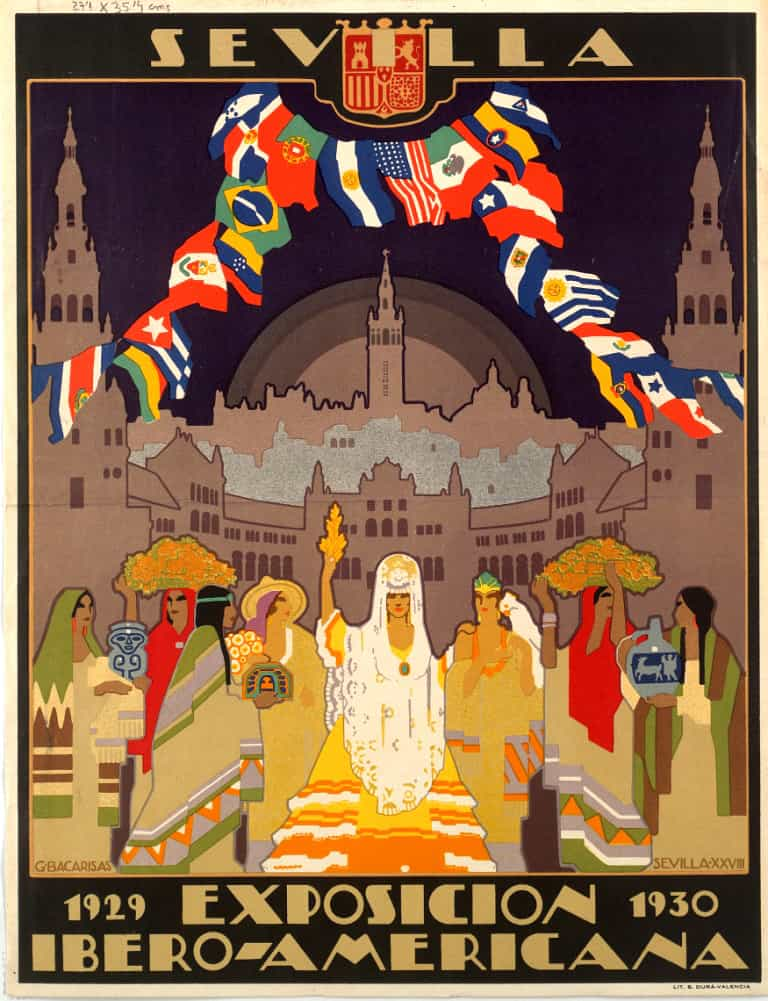
The 1929 Exposition left Seville with one of its most recognisable spaces: the Plaza de España, designed by Aníbal González. Built as the Spanish pavilion, it remains the highlight of any visit. Its semicircular colonnade, ceramic benches representing the Spanish provinces, canal and bridges form a theatrical setting that has appeared in films such as Lawrence of Arabia and Star Wars: Episode II.
Most of the surviving pavilions stand around María Luisa Park and can be explored on foot in a morning. A practical route begins near the former Seville Pavilion, now the Casino de la Exposición and the Lope de Vega Theatre. Nearby stand the pavilions of Peru and Chile. Crossing Avenida de María Luisa brings you to the Plaza de España itself.
Casino de la Exposición on the map · Lope de Vega Theatre on the map
Continuing south through the park you reach the Plaza de América, home to three permanent Spanish pavilions that now house museums: the Museum of Arts and Popular Customs (in the Mudéjar Pavilion), the Archaeology Museum, and the Royal Pavilion. Several Latin American pavilions also survive and are still in use as schools, consulates or cultural centres (Argentina, Chile, Colombia and Cuba among them).
Around 25 of the original buildings from 1929 remain. The area is one of the most coherent and best-preserved architectural legacies of any world fair.
Note: Access to Plaza de España is generally free, although a small tourist fee has been discussed in recent years and enforcement can vary. It is wise to check the situation on arrival.
Expo 92 on the Island of La Cartuja

Expo 92 was a true world’s fair that attracted more than 41 million visitors between April and October 1992. The site occupied the island of La Cartuja, previously separated from the city centre by the river. Major engineering works created the land needed for the exhibition.
Although many temporary structures were dismantled, more than 30 pavilions remain. The best starting point today is the Monastery of Santa María de las Cuevas (La Cartuja), extensively restored for the Expo and now home to the Andalusian Centre of Contemporary Art (CAAC). The centre regularly hosts temporary exhibitions and is fully open to visitors.
Monastery of La Cartuja on the map
Among the international pavilions still standing, the Morocco Pavilion is one of the best preserved. It now houses the Fundación Tres Culturas del Mediterráneo and can be visited on free guided tours (advance reservation required on selected dates). Other notable exteriors include those of Finland, France, Chile, Kuwait and Monaco.
Important update: The Navigation Pavilion (Pabellón de la Navegación), long one of the few Expo 92 buildings open as a museum, closed its permanent exhibition in June 2026. Its future use is currently under review. Check the latest information before planning a visit.
Part of the former Expo grounds is now occupied by the Isla Mágica theme park, while much of the rest forms a science and technology park. The architecture feels more varied and less integrated into the historic city than the 1929 legacy, yet it offers a different perspective on Seville’s modern ambitions.
Suggested itinerary
- Morning – 1929 sites: Start at Plaza de España, walk through María Luisa Park to Plaza de América and the surrounding pavilions. Allow 2–3 hours.
- Afternoon – La Cartuja: Cross to the island for the CAAC (Monastery of La Cartuja) and a stroll past the remaining Expo pavilions, including the Morocco Pavilion if a guided visit is available. Allow 2–3 hours.
The two areas are not adjacent, so plan transport between them (bus, taxi or a longer walk across the river bridges).
Getting to Seville from Malaga
Seville is approximately 200–220 km from Malaga Airport. The journey by car via the A-92 motorway usually takes between 2 hours and 2 hours 30 minutes. Once in Seville, the 1929 sites around María Luisa Park are easily reached on foot or by local bus from the historic centre, while La Cartuja lies a short distance across the river.

Car hire: the most flexible option
A hire car allows you to reach Seville at your own pace and combine the Exposition sites with other destinations in Andalusia.
Hire a car at Malaga Airport
Taxi or private transfer
If you prefer not to drive, a private transfer from Malaga Airport or your Costa del Sol accommodation can take you directly to Seville.
Book a transfer from Malaga Airport*There is no need to enter credit card details or make an advance payment. We recommend booking in good time.
Other transport options
High-speed and regional trains connect Malaga and Seville (journey time around 2 hours). Coaches also run regularly. Within Seville, local buses serve both María Luisa Park and La Cartuja; taxis are plentiful.
Practical tips
- Wear comfortable shoes – both areas involve a good amount of walking.
- In summer, plan outdoor sections for early morning or late afternoon.
- The 1929 sites combine very well with a visit to the nearby Alcázar or Cathedral.
- Check current opening times for the CAAC and any guided visits to the Morocco Pavilion.
- The Navigation Pavilion is currently closed; do not rely on it being open.
Frequently asked questions about the Route of the Expositions
What is the Route of the Expositions?
It is a way of exploring the architectural legacies of Seville’s two major 20th-century exhibitions: the Ibero-American Exposition of 1929 (centred on Plaza de España and María Luisa Park) and Expo 92 (on the island of La Cartuja).
Can I visit both areas in one day?
Yes. A practical plan is to spend the morning at the 1929 sites around María Luisa Park and the afternoon on La Cartuja. The two zones are not adjacent, so allow time for transport between them.
Is Plaza de España free to enter?
Access is generally free. A small tourist fee has been proposed and discussed in recent years; enforcement has varied, so it is best to check the situation on the day of your visit.
What can still be visited from Expo 92?
The Monastery of La Cartuja (now the CAAC contemporary art centre) is open and hosts regular exhibitions. The Morocco Pavilion offers guided visits by reservation. Many other pavilions can be seen from the outside. The Navigation Pavilion closed its permanent exhibition in June 2026.
How do I get from Malaga to the Exposition sites?
By car the journey takes roughly 2–2.5 hours via the A-92. Trains and coaches also run between Malaga and Seville. Once in the city, local buses and taxis connect the historic centre with María Luisa Park and La Cartuja.
Is the area suitable for families?
Yes. Plaza de España and María Luisa Park are pleasant for all ages. On La Cartuja, Isla Mágica theme park occupies part of the former Expo grounds and is a popular option for families with children.