Route of Historicism in Andalusia: from Neo-Mudejar to Regionalism
Andalusia’s architectural landscape is a rich tapestry of styles. Among the most distinctive is historicism (the 19th- and early 20th-century practice of reviving and reinterpreting historical architectural styles). A perfect starting point for understanding this movement is the small but highly significant Costurero de la Reina in Seville, built in 1893.
Despite its modest size, this Neo-Mudejar pavilion (a late 19th-century style that revived the medieval Mudejar architecture, which blended Islamic and Christian elements) stands as an early and eloquent symbol of the quality and evolution of historicist architecture in the region. From here, a journey through Andalusia reveals how architects looked back to the past to create buildings that still shape the character of its cities today.
What is historicism in architecture?
Historicism emerged in the 19th century as architects consciously reincorporated elements of earlier historical styles into new buildings. Rather than simply copying the past, they interpreted and adapted traditional forms to contemporary needs and tastes.
The result is a blend of old and new: buildings that feel rooted in history while serving modern functions. In Andalusia this approach found particularly fertile ground, drawing on the region’s rich Islamic, Mudejar, Gothic and Renaissance heritage.
Costurero de la Reina – the starting point
Built in 1893 by architect Juan Talavera y de la Vega in the gardens of the Palace of San Telmo (now part of Maria Luisa Park), the Costurero de la Reina is widely regarded as the first Neo-Mudejar building in Seville. Its octagonal form, exposed brickwork, turrets and decorative details give it a fairy-tale appearance that continues to captivate visitors.
Although popular tradition links it to Queen Mercedes, the building was actually constructed as a garden pavilion. Today it remains one of the most photographed and beloved examples of Sevillian historicism.
Revivalist architecture for institutional expression
While early 20th-century modernism often served commercial and middle-class domestic architecture, revivalist styles (architecture that deliberately imitates or reinterprets earlier historical periods) became the preferred language for institutional buildings. Clear examples include:
- The Provincial Palace of Jaen (Map)
- The Veterinary School of Cordoba (Map)
- The former Palace of Justice in Seville, now the Municipal Archive (Map)
These buildings used classical, neo-Renaissance or regional references to convey authority, permanence and civic pride.
Imaginative examples in leisure and cultural architecture
Some of the most inventive historicist designs appear in theatres and cinemas, where architects felt freer to experiment with decorative richness and regional motifs:
- Teatro Manuel de Falla in Cadiz – a striking Neo-Mudejar building inaugurated in 1910, with characteristic horseshoe arches and polychrome brickwork (Map)
- Coliseo España in Seville – a major regionalist theatre (a style that emphasised local Andalusian traditions) opened in 1931, designed by Jose and Aurelio Gomez Millan. Today it houses offices, though there are plans to return it to cultural use (Map)
- Teatro Albeniz in Malaga (Map)
The regionalist movement and the Ibero-American Exposition
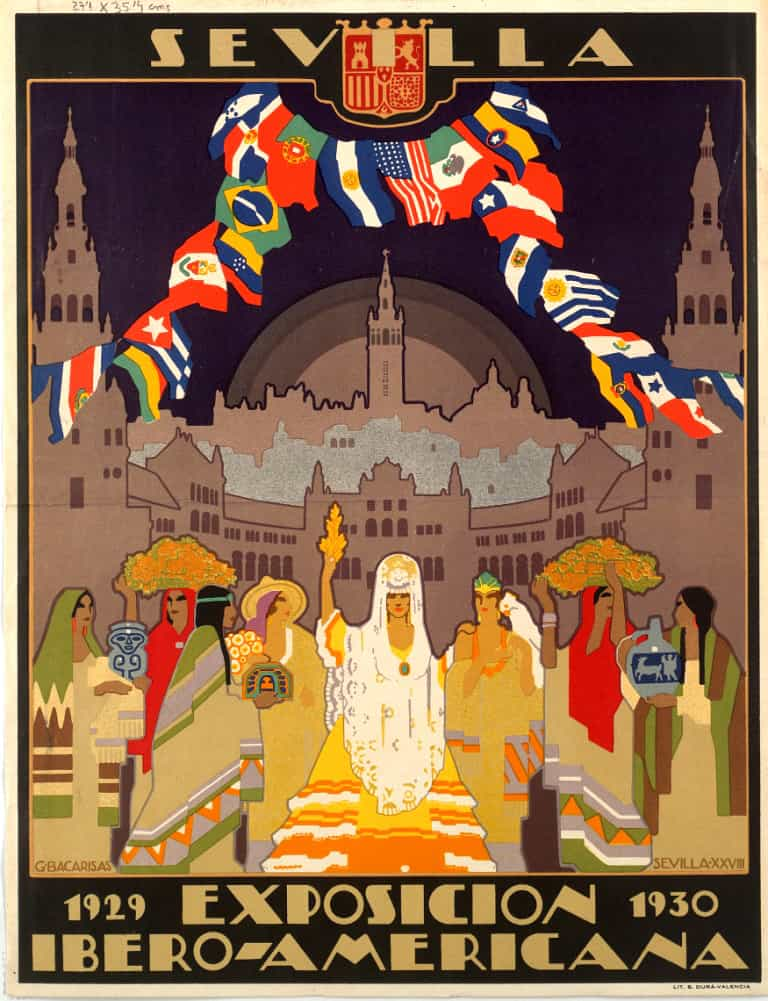
The regionalist movement (an architectural trend that emphasised local Andalusian forms and traditions as an expression of regional identity), which reached its peak around the Ibero-American Exposition of 1929, forms an important chapter in Andalusian historicism. It drew particularly on Mudejar and vernacular architecture.
Although the Exposition institutionalised regionalism and produced some of its finest examples (Plaza de España being the most famous), it represents only part of the broader historicist production that flourished across Andalusia from the late 19th century until the Civil War.
The transition towards modern architecture
By the 1930s a gradual shift towards modern architecture was underway. Buildings such as the Elcano Building and the Saenz House in Seville illustrate this determined passage from historicist and regionalist language towards more rationalist and modern forms, while still retaining occasional references to local tradition.
These works mark the end of the high period of historicism in Andalusia and the beginning of a new architectural chapter.
How to explore the Route of Historicism
Many of the finest examples are concentrated in Seville, Cadiz, Cordoba, Jaen and Malaga. A rewarding approach is to combine:
- A walk through Maria Luisa Park and the area around the Costurero de la Reina and Plaza de España in Seville.
- A visit to the Teatro Falla when in Cadiz.
- Selected institutional and cultural buildings in the other provincial capitals.
Most of these structures can be appreciated from the outside; some theatres and public buildings can also be entered when open for performances or exhibitions.
Getting around the historicist sites from Malaga
Because the key examples of historicism are spread across several Andalusian cities, a car offers the greatest flexibility for following this architectural route at your own pace.

Car hire: the most flexible option
A hire car from Malaga Airport allows you to visit Seville, Cadiz, Cordoba and other cities with important historicist buildings without depending on public transport timetables.
Hire a car at Malaga Airport
Taxi or private transfer
If you prefer not to drive, you can book a private transfer from Malaga to Seville or another city and explore the historicist architecture on foot or by local transport.
Book a transfer from Malaga Airport*There is no need to enter credit card details or make an advance payment. We recommend booking in good time.
Frequently asked questions about historicism in Andalusia
What is architectural historicism?
Historicism is a 19th- and early 20th-century architectural approach that revives and reinterprets historical styles (such as Mudejar, Renaissance or Baroque) in new buildings, adapting them to contemporary needs.
What does Neo-Mudejar mean?
Neo-Mudejar is a late 19th-century architectural style that revived the medieval Mudejar tradition (the blending of Islamic and Christian architectural elements that developed in Spain after the Christian reconquest).
How is regionalism related to historicism?
Regionalism is a particular form of historicism that emphasises local Andalusian traditions, especially Mudejar and vernacular architecture. It reached its peak around the Ibero-American Exposition of 1929.
Which cities have the best examples of historicist architecture?
Seville has the highest concentration, followed by Cadiz (Teatro Falla), Cordoba, Jaen and Malaga. Many provincial capitals and larger towns also preserve interesting examples.
Can I visit these buildings inside?
Some, such as theatres when performances are on, or public buildings with visitor access, can be entered. Others are best appreciated from the exterior. Always check current opening arrangements.