



- Dehesa — open woodland of holm oak or cork oak, used as pasture. Iberian pigs feed here on acorns in winter.
- Jamón ibérico — cured ham from Iberian pigs raised on these hills, especially around Jabugo and El Repilado.
- Gruta — a show cave. Las Maravillas is the one under Aracena.
Sierra de Aracena and Picos de Aroche
The west end of Sierra Morena is a worn, green plateau rather than a sharp sierra. Holm oak and cork oak open into dehesa — pasture under trees — where Iberian pigs fatten on acorns. Further west the ground turns wetter: chestnut woods, springs, and valleys of pear and apple. Under Aracena the rock is hollow. The Gruta de las Maravillas runs for more than a kilometre of galleries you can walk with a ticket.
This is a two-day drive from the Costa del Sol, or a full day if you are already in Huelva or Seville. Related page: Huelva.
*Book the Gruta de las Maravillas before you arrive. Village shops selling ham keep morning hours.
Words you will meet
Santa Olalla, Hinojales and the dehesa
From the east the park begins as grey-green pasture. Santa Olalla de Cala has a thirteenth-century castle on the ridge. Arroyomolinos de Leon is a start for Pico Bonales, the highest point in Huelva province if you want a walk with a name. Canaveral de Leon has a small lagoon used as a summer swimming hole and a viewpoint at El Puerto.
Hinojales sits where the dehesa is still the main picture: holm oak, cork in the damper pockets, pigs under the trees. That landscape is the point of this first stretch, not another church interior.
Chestnuts, Fuenteheridos and the ham villages
From Hinojales toward Cortegana the colour changes. Chestnut takes over from pasture. In summer it is a hard green; in autumn the hills go rust and pink. Los Marines is a chestnut village with a walk of ceramic panels for the twenty-nine towns of the sierra. Fuenteheridos is the garden stop: Villa Onuba holds a Spanish fir and a sequoia among other trees, and the valleys below grow pears and apples.
Galaroza has the Fuente de los Doce Canos, a twelve-spout spring in the street. El Repilado, on the way to Jabugo, is where the ham trade sits in plain view — drying rooms, bars that serve the thing you came to taste. Cortegana keeps a medieval castle and old water mills on a signed path.
Aroche, Almonaster and Alajar
West again the land flattens into pasture and heath toward Aroche. Black vultures use this open ground. Aroche has a castle and Roman remains. Almonaster la Real keeps a castle with a tenth-century mosque inside it, now a hermitage — the interior to enter if you only climb one hill.
Alajar is the viewpoint. The Peña de Arias Montano holds the hermitage of Nuestra Senora de los Angeles: a rock over the chestnut valleys, and the usual end of the drive if you want a single photograph that explains the sierra. Linares de la Sierra is the next white village down the path, useful as a walk from Alajar or from Aracena, not as a separate destination.
Aracena
Aracena is the practical base: rooms, the cave, a castle on the hill. The Gruta de las Maravillas is a show cave of lakes and formations, more than a kilometre of public galleries. Buy the ticket in town. The castle above gives the plan of the roofs and the first folds of the park.
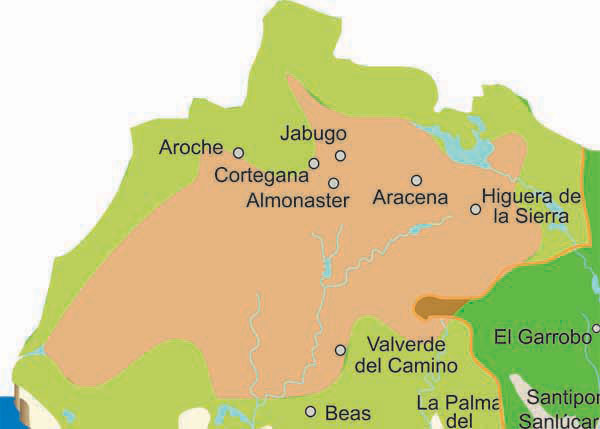
Road map
Santa Olalla de Cala to Aracena is the usual line, with a west loop to Cortegana or Aroche if you have the second day. The chestnut belt around Fuenteheridos and Alajar is the middle of the park.
How to reach the Sierra de Aracena
From Seville the N-433 runs straight into the park. From Huelva city it is a northbound drive of about an hour to Aracena. From the Costa del Sol it is a long crossing of Andalusia; sleep in Aracena.

Car hire: the flexible option
The practical way to see the dehesa, a chestnut village and Alajar in one loop. Buses reach Aracena; they do not follow the ridges.
Hire a car at Malaga Airport
Taxi or private transfer
From Malaga Airport or the Costa del Sol to a hotel in Aracena. A same-day return from the Costa is a very long day. Stay the night.
Book a transfer*No credit-card details or advance payment are needed to request a quote. Cancellation is free. Book ahead in high season to avoid price rises and to secure the car or group size you need.
Other options
Buses run to Aracena from Huelva and Seville. A local train serves some ham villages, including El Repilado. For Fuenteheridos, Alajar and Aroche you still want a car from Aracena.
Practical tips
- Use Aracena as the base. See the cave first, then drive west into the chestnuts or the dehesa.
- Autumn is the season if you came for colour. Summer is ham, shade and swimming holes.
- Taste the ham in El Repilado or Jabugo. Buying a vacuum pack to take home is normal; keep it cool.
- The Peña de Arias Montano at Alajar is the viewpoint. Leave time before dusk; the lane is narrow.
- Almonaster’s mosque is a short climb and a different century from the dehesa. Worth the stop if you are already west of Cortegana.
Frequently asked questions about the Sierra de Aracena
Do I need to book the cave?
Yes. The Gruta de las Maravillas in Aracena works on timed visits. Buy a ticket before you count on going in.
Where does the ham come from?
From Iberian pigs raised on the dehesa, then cured in villages such as Jabugo and El Repilado. The acorn season is winter.
How far is it from Malaga?
A long drive across Andalusia — plan on three hours or more. Stay in Aracena. From Seville it is much shorter.
What is a dehesa?
Open woodland of holm oak or cork oak, used as pasture. In the east of this park it is where Iberian pigs fatten on acorns before the ham is cured.
Where should I go for a view?
The Peña de Arias Montano above Alajar. The castle at Aracena is the town view.
Do I need a car?
A bus or a transfer will get you to Aracena. A car is how you reach Fuenteheridos, Alajar and Aroche in the same trip.


