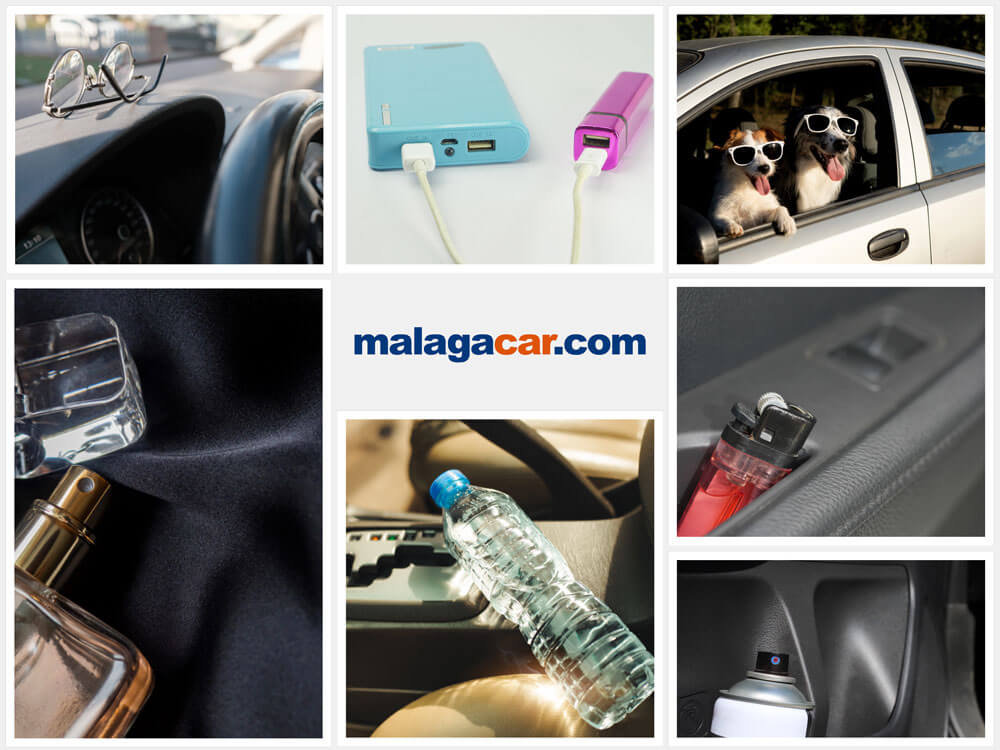
Many of our visitors underestimate the extreme heat experienced during the peak season months on the Costa del Sol. Take a couple of minutes to read our tips on what you should never leave in your car in Summer
While some items may seem obvious, others might not have even crossed your mind. Keep our advice in mind to ensure a trouble-free driving experience during your vacation in Malaga.

- No refuelling fee
- Free cancellation
- Hire without intermediaries
- Pay when you pick up your car

Don’t underestimate the heat in Malaga in summer
Underestimating the heat in Malaga is a common mistake, due to the false sense of coolness sometimes provided by the sea breeze—especially when compared to the dry heat of the province’s interior.
In summer, temperatures in Malaga typically exceed 30–33°C, and sweltering nights (where temperatures do not drop below 25°C) are frequent.

Furthermore, the Terral wind can send thermometers soaring in an instant. This strong, superheated wind can suddenly drive temperatures up—exceeding 40ºC in a matter of hours—transforming Malaga into a dry oven.
With outside temperatures ranging from 30 to 35ºC, the interior of the vehicle can exceed 60ºC in less than an hour. This increases the risk of an accident by 20% by diminishing reaction time and causing drowsiness.
- Here are some valuable tips for driving in Malaga during the summer.

What you should never leave in your car in Summer
For many of us, our cars gradually fill up over time with all sorts of useful and personal items that we want to keep close at hand—without realizing that some of them can pose a potential danger during the hot summer months.
Under conditions of extreme heat—such as those found during the summer in southern Spain—leaving certain objects inside a car can have unforeseen consequences. The temperature inside a car parked under the summer sun can exceed 80°C, which is sufficient to cause many objects to catch fire or explode.
Below, we present everything you should avoid leaving in your car at all costs during the summer in Malaga.
Children and Animals
Given the extreme danger to their health and lives, number one on our list are children and animals.

Under no circumstances should you leave children or animals in the car during the summer.
Nor should you do so even in the shade with the windows slightly rolled down. Leaving the windows slightly open does not prevent the greenhouse effect, nor does it significantly reduce the rate at which the interior temperature rises.
Even with a moderate outside temperature of 25ºC, the interior of a vehicle heats up to dangerous levels in just 10 minutes.
With outside temperatures of 30ºC, the interior of a vehicle can exceed 50ºC within minutes, causing fatal heatstroke. In just 10 minutes, the interior of a vehicle can heat up by 15 degrees, raising a child’s body temperature to over 42ºC.
Children and pets are particularly vulnerable because their bodies heat up three to five times faster than those of adults. Heatstroke can be fatal.
Tragic cases have been recorded in Spain, the most recent being that of a two-year-old child who died in July 2025 after being forgotten inside a vehicle in direct sunlight. Regarding dog deaths caused by heatstroke in cars, unofficial figures amount to thousands worldwide.
Lighter
Many people tend to have the habit of keeping an extra lighter in the glove compartment. Well, that small, seemingly harmless lighter can turn into a mini-bomb.

Due to the intense heat inside a car parked in the sun, the gas in a lighter expands rapidly and can explode unexpectedly.
Many car fires have been recorded as a result of leaving a lighter on the dashboard or in the glove compartment—even for a short period of time.
External battery
The lithium-ion batteries in portable chargers are highly sensitive to high temperatures. When they overheat, they can swell, leak or even explode.

The temperature inside a parked car is extremely high—high enough to damage the battery, reduce its lifespan and cause fires or explosions.
Therefore, always keep your portable batteries out of the car and avoid exposing them to direct sunlight.
Perfume bottle
If you like to leave a bottle of your favorite perfume in the car to freshen up after the beach, you’d better start putting it in your beach bag from now on.

Most perfumes contain alcohol, a highly volatile substance.
When exposed to high temperatures inside a car, the pressure inside the bottle can rise rapidly, increasing the risk that it will crack or even explode.
Water bottle
Almost all of us have a bottle of water in the car during the hot summer in Malaga. It doesn’t even have to be a glass bottle.

Well, even a clear plastic bottle in the sun acts like a lens, concentrating light onto a single point and increasing the risk of fire.
Furthermore, high temperatures inside the vehicle can cause compounds from the plastic to leach into the water.
Glasses
Well, the very same thing we just said about water bottles applies to glasses, creating a magnifying-glass effect in the sun.

This risk is particularly high if the glasses are placed on the dashboard, where they are directly exposed to sunlight and temperatures can rise significantly.
Furthermore, extreme temperatures can warp the frames and damage the protective coating on the lenses.
Aerosols
Aerosols—such as deodorants or air fresheners—can also turn into small bombs.
Avoid leaving them in the car, as the pressure inside the container increases along with the temperature.

If you need to keep a deodorant handy, it is best to store it in a cool, dry place—away from direct sunlight—or take it with you when you leave the car.
Canned drinks
Well, overheated Coca-Cola won’t just taste terrible; it can also pose a potential hazard if left in a car in high temperatures. Heat causes the liquid to expand, which increases the pressure inside the can and can cause it to crack or the lid to pop off.
Although the consequences are not inherently dangerous, they can damage upholstery or electronic equipment.
Medications
Most medications are sensitive to high temperatures. If you leave them inside a car, their active ingredients can be altered or quickly lose their effectiveness.
It is best to carry them with you or store them in a temperature-controlled environment.
Important to know if you rent a car in Malaga

And take note—in case you weren’t aware—with rental cars in Malaga, damage to the vehicle’s interior is generally not covered by insurance.
Any damage caused during the rental period due to misuse or improper use must be paid for by the customer.
The same applies if the vehicle requires specialized cleaning, the cost of which can amount to several hundred euros that you will have to pay out of pocket.


 Typical Summer fines driving in Spain – Myths and Facts
 Tips for Driving in Summer in Malaga
 Things you should never do on Malaga’s beaches