Welcome to the mysterious world of the Antequera Dolmens, a journey to our origins.
Antequera Dolmens: A Journey into the Heart of Andalusian Megalithism
Delve into the ancient mystery of the Antequera Dolmens, a unique megalithic complex in the province of Malaga and a UNESCO World Heritage Site. These impressive constructions, evoking a sacred and enigmatic past, will transport you to an era where the first civilisations left their mark on Andalusian soil.
Within an area of just three kilometres, you will discover three megalithic monuments that stand out for their uniqueness and monumentality:
Menga Dolmen
Viera Dolmen
El Romeral Tholos
The concentration of these ancient structures in Antequera demonstrates the great importance this area held in the past, possibly being a ceremonial and social centre for the first agrarian communities.
Unravelling the Secrets of Each Dolmen
The Imposing Menga Dolmen
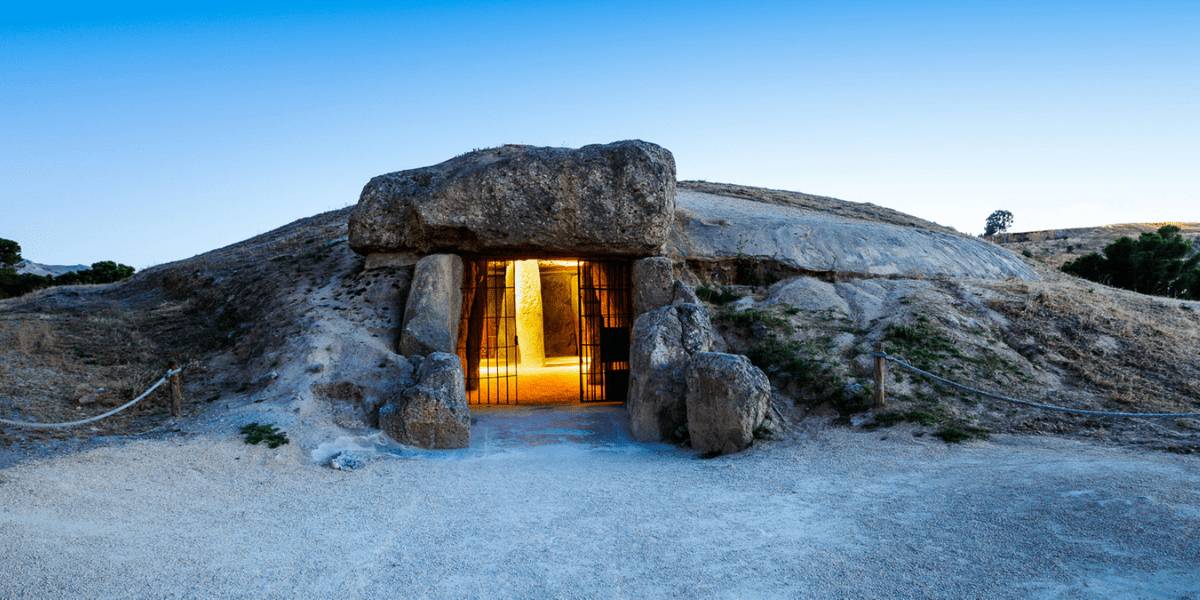
The majestic entrance to Menga Dolmen.
The Menga Dolmen is a masterpiece of European megalithic architecture. It consists of a covered gallery formed by five colossal stone slabs, one of which is estimated to weigh 180 tons. Its impressive size and the perfection of its construction make it one of the most spectacular and enigmatic dolmens on the continent.
The Enigmatic Viera Dolmen
A spectacle of light and colour in the heart of a dolmen.
Just 70 metres from the Menga Dolmen, you'll find the Viera Dolmen. This monument features a corridor design culminating in a burial chamber, offering a different perspective on the burial and ritual practices of the era.
The Unique El Romeral Tholos
The intricate interior of El Romeral Tholos.
The El Romeral Tholos, although constructed with smaller stones than its neighbours, is no less fascinating. Its structure resembles the Viera Dolmen, with a corridor leading to a circular chamber, a distinctive feature of tholoi, suggesting an evolution in the construction techniques and beliefs of its builders.
A Glimpse into the Origin and Megalithic Culture
It is estimated that these monumental constructions were erected between 3000 and 2000 BC, although their age could be even greater. Their construction required an organised society, with a considerable population density, clear social hierarchy, and a profound knowledge of engineering. It is likely they were the work of the first agricultural civilisations that settled in the region, developing a culture and beliefs rooted in the land.
A visit to the Antequera dolmens offers a unique opportunity to connect with a distant past and reflect on the ability of our ancestors to create such enduring works.
Beyond the Dolmens: Discover the Surroundings of Antequera
Your prehistoric adventure doesn't end at the dolmens. A short distance away, east of the monuments and at an altitude of about 200 metres, lies Marimacho Hill. Here, vestiges of a small village with underground houses, dated between 2600 and 2200 BC, were discovered. It's tempting to imagine that the inhabitants of this village, along with other nearby communities, actively participated in the construction of the dolmens. Although time has erased the details of their involvement, this site complements the experience, offering a more complete vision of prehistoric life in Antequera.
Exploring the Antequera Dolmens is to immerse oneself in a millennial legacy that continues to astound researchers and visitors alike.
How to Get to the Antequera Dolmens? Your Transport to History!
To make your visit to the Antequera Dolmens as comfortable and enriching as possible, we offer you the best transport options. Getting to this fascinating historical destination is easier than you think!
Explore at Your Own Pace with a Hire Car
The most flexible way to get to the Antequera Dolmens and explore their surroundings is with a hire car. From any point on the Costa del Sol, the journey is simple and will allow you to enjoy the Andalusian landscape at your own pace. You'll have the freedom to visit other nearby points of interest in Antequera, such as El Torcal, or simply stop wherever you wish. Adventure awaits!
If you prefer a worry-free experience, especially if travelling in a group or with luggage, we recommend booking a private taxi. Our service will pick you up at your location and take you directly to the Antequera Dolmens, guaranteeing a comfortable and safe journey. It's the ideal option for those seeking maximum convenience and a direct transfer without waiting. Relax and enjoy the ride!
Public Transport: While it's possible to reach Antequera by public transport from Malaga, keep in mind that schedules and connections may require more planning. Once in Antequera, you'll need to consider how to get to the Dolmens complex, which is located on the outskirts of the city. For greater comfort and flexibility, especially if your time is limited, car hire or private taxi options are highly recommended.
MengaStones Festival
The MengaStones Festival has established itself as an unmissable event in Antequera's summer. Born to commemorate the anniversary of the declaration of the Antequera Dolmens Site as a World Heritage Site, this festival spans from the summer solstice to the autumn equinox, offering a rich agenda of activities that merge culture, history, and nature.
Get ready to experience unique moments in an unparalleled megalithic setting. Below, we present a summary of what you can expect each month during the festival:
Activity Programme
June: The Summer Solstice and Creative Workshops
June kicks off with the mystical Sun Celebration at the Summer Solstice in Menga Dolmen. You can witness how the sun illuminates the northern side of the monument, revealing the ancient orientation towards Peña de los Enamorados. Furthermore, youngsters can enjoy the "Summer in Dolmens" Summer Workshops, fun activities that bring prehistory to life in an entertaining and creative way.
July: Music Under the Moon and Anniversary Celebrations
July lights up with the Full Moon in Menga Cycle, offering nocturnal concerts in the impressive atrium of the dolmen, where music merges with the magic of the night. This month also marks the 9th Anniversary of the Declaration of the Antequera Dolmens Site as a World Heritage Site, with inaugurations of temporary exhibitions on megalithism, an emotional musical celebration of flamenco and poetry, and a captivating theatrical celebration for the whole family. Additionally, you can immerse yourself in the past with the "Explorers of the Past" family role-playing game.
August: Archaeology, Stars and Adventures
In August, the Full Moon in Menga Cycle continues with new musical proposals under the starry sky. International Archaeology Day is celebrated with participatory re-enactments that bring prehistory to life. Don't miss the magical Perseid Astronomical Observation, an unforgettable experience to witness the meteor shower. The "Explorers of the Past" role-playing game also has a new session to continue unravelling the mysteries of the dolmens.
September: Stories, Eclipses and the Autumn Equinox
The festival concludes in September with the last gathering of the Full Moon in Menga Cycle, closing the musical nights under the stars. Narrative comes alive with the "A Hundred Cultures and Four Tales" Family Storytelling, a journey through the stories of Andalucia. Furthermore, the sky offers a unique spectacle with the Astronomical Observation of the Total Lunar Eclipse visible from Antequera. The grand finale is the Autumn Equinox Sun Celebration at the Dolmen de Viera, where you can observe how the sun and the play of shadows create a magical atmosphere that's truly worth experiencing.
Ongoing Activities Throughout the Summer
Throughout the summer, the Antequera Dolmens Archaeological Complex offers additional opportunities to explore its richness:
Moonlight Night Visits: Explore the majesty of Menga and Viera under the moonlight, a magical and different experience. Available every Tuesday and Thursday from July to September.
Daytime Guided Tours: Enjoy guided tours that will immerse you in the exceptional values of this World Heritage Site, available from Tuesday to Sunday mornings throughout the year.
More Information
To find out all the details of each event, schedules, capacities, and how to register, we invite you to visit the official website of the Antequera Dolmens Archaeological Complex. There you will find the most up-to-date information to plan your visit and make the most of this unique heritage in Andalucia.
Frequently Asked Questions about the Antequera Dolmens
What are the Antequera Dolmens?
The Antequera Dolmens are a monumental complex of three megalithic constructions (Menga Dolmen, Viera Dolmen, and El Romeral Tholos) located in the town of Antequera, Malaga. They are large prehistoric edifices, built with enormous stone blocks, primarily used as collective tombs and ceremonial centres. They are declared a UNESCO World Heritage Site.
How long does it take to visit the Antequera Dolmens?
A complete visit to all three dolmens (Menga, Viera, and El Romeral) and the interpretation centre usually takes between 2 and 3 hours. The time may vary if you decide to explore the surroundings or the centre of Antequera.
How much does it cost to visit the Antequera Dolmens?
Entry to the Antequera Dolmens is free for European Union citizens. A symbolic fee may apply to visitors from other countries. It is recommended to consult the official website of the Antequera Dolmens Archaeological Complex for the most up-to-date information on opening hours and potential fees.
Who built the dolmens?
It is believed that the dolmens were built by the first agricultural and livestock-rearing civilisations that settled in the Antequera area approximately 5,000 to 4,000 years ago (Late Neolithic and Copper Age). They were communities with an advanced social organisation, capable of mobilising large human and material resources for these monumental works.