From Prehistory to Islam: a journey through Andalusia’s early history
Andalusia’s story stretches from the earliest human presence to the flourishing of Al-Andalus. Neanderthal remains have been found in caves around Gibraltar, while later Phoenician, Greek and Carthaginian traders left their mark on coastal cities such as Cadiz and Malaga. In 711 AD forces from North Africa crossed the Strait of Gibraltar, and for the next seven centuries much of the region formed part of the Islamic world. The great monuments of that period – above all the Mosque-Cathedral of Cordoba, the ruined palace-city of Medina Azahara and the Alhambra in Granada – still define the cultural landscape of Andalusia today.
Cordoba and Granada – centres of medieval learning and culture
Cordoba and Granada ranked among the most prosperous and cosmopolitan cities in medieval Europe. Their position on trade routes between East and West attracted a diverse population of Muslims, Christians and Jews. This coexistence was reflected in the urban fabric: mosques, churches and synagogues stood close to one another, and Cordoba in particular became a major centre of scholarship, with one of the largest libraries in Europe and a university that drew students from far beyond the Iberian Peninsula.
Visitors interested in the deeper past can also explore Roman remains such as the well-preserved city of Italica near Seville, or the prehistoric paintings and formations of the Cueva de Nerja. No itinerary of this period is complete, however, without the great Islamic monuments, culminating in the Alhambra in Granada, a UNESCO World Heritage Site celebrated for its architecture, tilework and gardens.
Medina Azahara – the Shining City

Just 8 km west of Cordoba lie the ruins of Medina Azahara (Madinat al-Zahra, “the Shining City”), the palace-city founded around 936–941 by the caliph Abd al-Rahman III. For decades it served as the administrative and ceremonial heart of the Caliphate of Cordoba before being sacked in the early 11th century and largely forgotten.
Excavations began in earnest in 1911. What has been uncovered – audience halls, gardens, administrative buildings and sophisticated water systems – gives a vivid sense of the scale and refinement of caliphal culture. The site is a UNESCO World Heritage Site and one of the most important archaeological complexes in Spain.
A visit is best planned with time in hand; a shuttle bus links the visitor centre with the archaeological area. View Medina Azahara on the map · Route from Malaga Airport.
Essential monuments in Cordoba

The Mosque-Cathedral
Construction of the Great Mosque of Cordoba began in 785 under Abd al-Rahman I. Expanded over the following centuries, it became one of the largest mosques in the Islamic world. After the Christian conquest a cathedral was inserted into the heart of the building rather than demolishing it – a decision that has preserved the forest of more than 1,300 columns and the famous red-and-white arches.
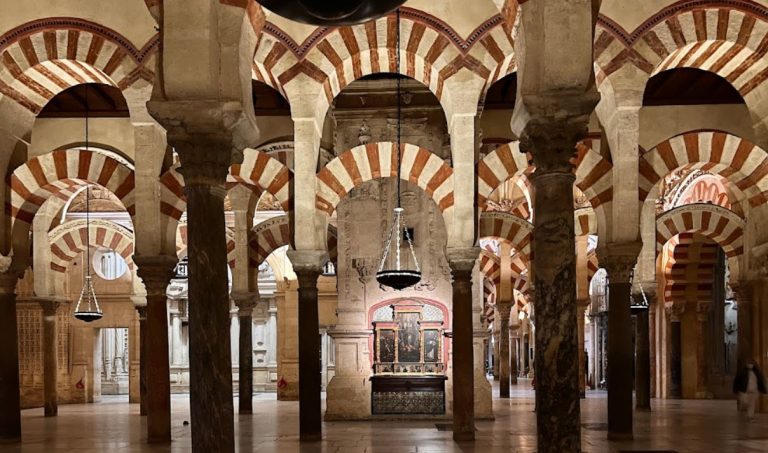
Advance booking is strongly recommended, especially in high season. Location.
Mudejar Chapel of San Bartolome
Built between the late 14th and early 15th centuries, this small chapel is one of the finest surviving examples of Mudejar architecture (the style developed by Muslim craftsmen working under Christian rule) in Cordoba. Its intimate scale, intricate tilework and quiet atmosphere make it a rewarding contrast to the grandeur of the Mosque-Cathedral.
Other important sites in Cordoba
- Synagogue of Cordoba – the only surviving medieval synagogue in Andalusia, built in 1315 and located in the Juderia (Jewish Quarter). Admission is free for EU citizens.
- Calahorra Tower – now a museum dedicated to the three cultures (Muslim, Jewish and Christian) that shaped medieval Cordoba.
- Plaza de la Corredera – a large historic square; remains of a Roman circus have been identified in the area.
- Archaeological Museum – essential for understanding the city’s long sequence of occupation. Map.
Towards Granada and the Alhambra
The itinerary continues eastwards through a chain of attractive inland towns before reaching Granada, the last Muslim kingdom on the Iberian Peninsula and home to the Alhambra.


For practical advice on reaching the city, see our guide: Granada from Malaga by car.
Suggested itinerary
This route moves from the caliphal heartland around Cordoba eastwards towards Granada:
Exploring the route from Malaga
Medina Azahara, Cordoba and the chain of towns leading towards Granada are best visited with your own transport. A car allows you to combine the major monuments with the quieter inland stops on the itinerary.

Car hire: the most flexible option
Hiring a car at Malaga Airport gives you the freedom to visit Medina Azahara, spend time in Cordoba and continue at your own pace towards Granada.
Hire a car at Malaga Airport
Taxi or private transfer
If you prefer not to drive, a private transfer can take you directly to Cordoba or Granada as a base for exploring the main monuments.
Book a transfer from Malaga Airport*There is no need to enter credit card details or make an advance payment. We recommend booking in good time.
Frequently asked questions
What is Medina Azahara?
Medina Azahara was the palace-city built by Caliph Abd al-Rahman III in the mid-10th century a short distance from Cordoba. It served as the political and ceremonial centre of the Caliphate before being destroyed in the early 11th century. Extensive ruins have been excavated and are open to visitors.
Do I need to book the Mosque-Cathedral in advance?
Yes. Especially in spring, autumn and during peak holiday periods, advance online booking is strongly advised to avoid long queues.
Is the Chapel of San Bartolome worth visiting?
Yes. It is a beautifully preserved example of Mudejar architecture and offers a quieter, more intimate experience than the major monuments.
How far is Medina Azahara from Cordoba?
Approximately 8 km west of the modern city centre. A shuttle bus runs from the visitor centre to the archaeological site itself.