Since 1993, Spain has been developing the Vias Verdes – an ambitious initiative that transforms disused or unfinished railway lines into appealing leisure paths. In this way, these once-abandoned routes gain new purpose, offering cyclists and walkers the chance to enjoy nature in a peaceful, traffic-free setting.
The province of Cadiz is home to three standout Vias Verdes. Two are more recent creations, while the third – the renowned Vía Verde de la Sierra – ranks among Andalucia’s most spectacular trails.
The Vias Verdes of Cadiz
Vía Verde Bahía de Cádiz
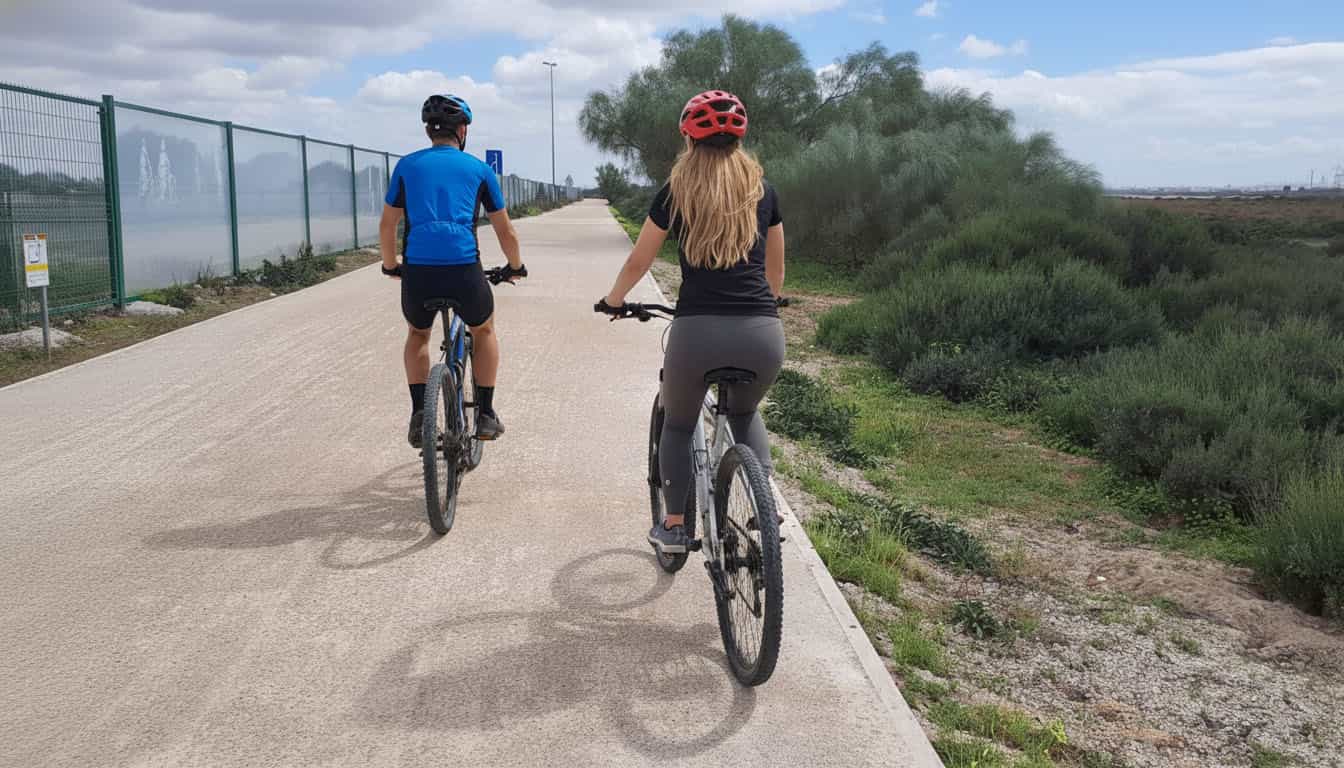
This 8-kilometre route links Puerto Real with San Fernando. The original railway became redundant after the suburban train line between Jerez and Cadiz opened, allowing the track to be converted into a green corridor running parallel to the coast.
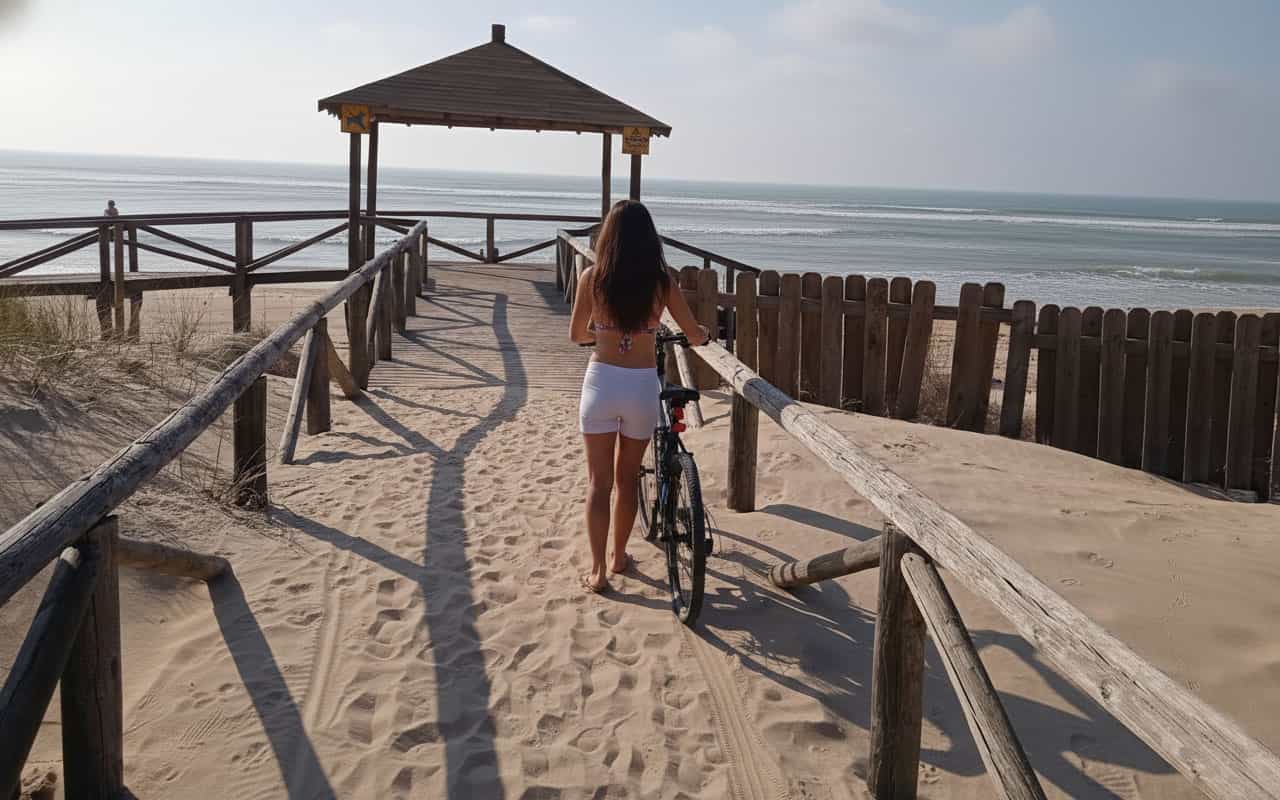
In Rota, this 7-kilometre path runs from Costa Ballena to Avenida de la Libertad. Plans exist to extend it in future as far as Chipiona, further enhancing the coastal section.
Enjoying beach and nature on the Vía Verde Costa Ballena
At 36 kilometres long, this route stretches between Puerto Serrano and Olvera through some of southern Spain’s finest scenery. The line was abandoned after the Civil War and never entered regular service.
The starting point is the former station at Puerto Serrano (Map), where accommodation, a restaurant and parking are available. Along the way, working water mills line the banks of the River Guadalete.
Just before kilometre 9, the path enters a long tunnel with automatic lighting. We recommend bringing a torch – the system is reliable but not infallible.
At kilometre 0 lies the Parque de la Unión de los Ríos – another access point with parking for those who prefer a shorter section.
At kilometre 15 you reach Coripe station, now converted into a hotel-restaurant and a useful alternative starting point.
At kilometre 20 is Zaframagón station (Map), transformed into an interpretation centre. Here you can learn about Andalucia’s natural parks, other Vias Verdes and, in particular, the griffon vulture – complete with live cameras at the nests.
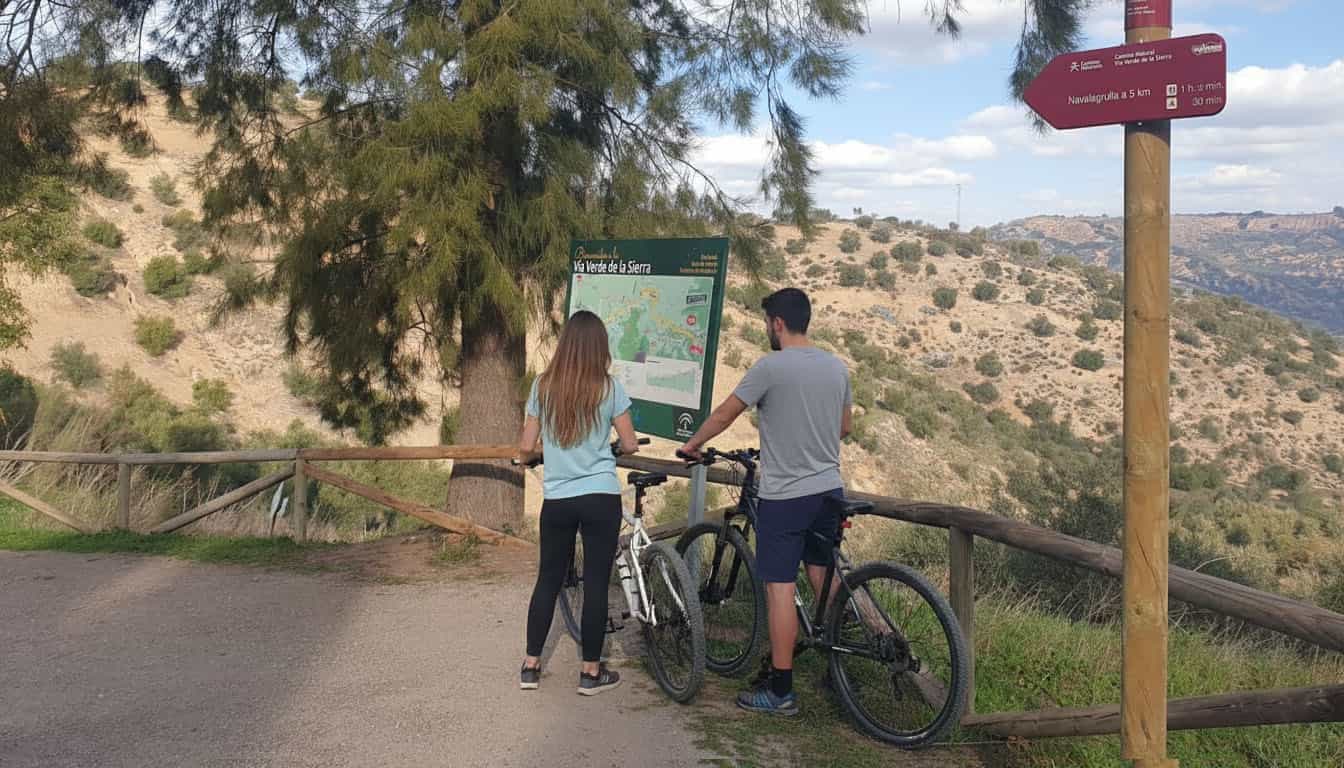
Cycling towards the old Navalagrulla station on the Vía Verde de la Sierra
At kilometre 27.3 lies the remote Navalagrulla station with no further facilities.
Finally, at kilometre 35, the route ends at Olvera station (Map) after passing through numerous additional tunnels. This station has also been turned into a hotel and restaurant – the perfect place to relax at the end of the day.
Activities on the Vias Verdes
The routes are designed specifically for relaxed enjoyment of the countryside. Popular pursuits include walking, cycling and birdwatching – especially the griffon vulture on the Vía Verde de la Sierra. Most sections are low-difficulty and suitable for families or, in places, even adapted wheelchairs.
Walking: The full route or selected stages, depending on time available.
Cycling: The compacted surface is ideal for mountain or hybrid bikes.
Birdwatching: Particularly around the Peñón de Zaframagón, home to a large griffon vulture colony.
Nature photography: Tunnels, viaducts, rivers and mountain scenery provide countless subjects.
Getting to the Vias Verdes in Cadiz
The Vias Verdes of Cadiz are located in rural areas with limited public transport links. The most flexible and convenient option – especially for the Vía Verde de la Sierra with its multiple access points – is to have your own vehicle. This allows you to explore the surrounding area freely, visit nearby white villages and combine several routes in one trip.
Car Hire: Complete Flexibility
Collecting a hire car directly at Malaga Airport lets you drive straight to Puerto Serrano, Olvera or any chosen starting point on the Vias Verdes, while also opening up other parts of Cadiz and Sevilla for exploration.
A taxi or private transfer from Malaga Airport takes you straight to your selected starting point without changes – ideal if travelling with equipment or in a group.
*No credit card details are required and no advance payment is necessary. We recommend booking well ahead to secure the best prices and availability.
Other transport options
Regional buses (such as Damas or Comes) connect Malaga with Olvera and Puerto Serrano, though timetables are limited and changes are usually required. Once in the towns, the route entrances are within walking distance. There is no direct train connection.
Is the Vía Verde de la Sierra suitable for families with children?
Yes, the route is low-difficulty and many sections are easily accessible. We suggest tackling only part of it and taking plenty of water and sun protection.
How much time is needed for the full Vía Verde de la Sierra?
On foot, 8–10 hours; by bike, 4–6 hours, depending on stops. Most visitors opt for shorter sections.
Is bicycle hire available along the route?
Yes, bikes are generally available for hire at Puerto Serrano and Olvera stations, though availability varies by season.
Can you see griffon vultures during the route?
Yes, especially around the Peñón de Zaframagón, which hosts a large colony. The interpretation centre provides live footage from the nests.
Is the route accessible for people with reduced mobility?
Some sections are wheelchair-friendly (particularly the asphalted parts), though gradients and gravel areas can make access more challenging.
What is the best time of year to visit?
Spring and autumn offer pleasant temperatures and fewer crowds. Winter can bring rain, while summer calls for an early start to avoid the heat.